- This company is planning a lithium empire from the shores of the Great Salt Lake
- A $250 Million Plan To Pull Lithium For Batteries From The Great Salt Lake
- There’s a Better Way to Mine Lithium — At Least in Theory
- Lilac signs 10-year deal with Traxys to supply lithium from Utah project
- Traxys target build out of US domestic lithium supply chain: interview
- How to extract lithium from the Great Salt Lake (without depleting water levels)
Lilac IX Gen 5
Next Generation Ion Exchange Technology for Lithium Extraction
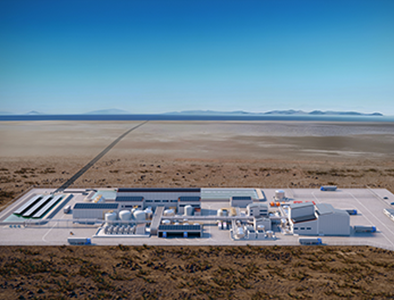
Problem
Lithium is essential for electric vehicle batteries and renewable energy storage, yet traditional extraction from brines relies on conventional adsorbents which require large amounts of energy, water, and land. These factors drive up production costs, especially for U.S. projects with lower lithium grades. Most adsorbents are also sourced from China, introducing geopolitical risk into domestic lithium projects. As demand accelerates, the industry needs more efficient and scalable technologies that can unlock new brine resources while reducing costs and environmental impact.
Solution
Lilac Solutions’s fifth-generation ion exchange technology represents a major advance in direct lithium extraction (DLE) using ion exchange technology. This system delivers lithium recoveries of over 90% while rejecting more than 99% of impurities, ensuring high purity output suitable for battery production. It is engineered for long cycle life and high throughput, making it durable and scalable for commercial deployment. By eliminating evaporation ponds and enabling extraction from lower-grade brines, Lilac redefines what constitutes a viable resource, expanding the global supply base and improving project economics. Lilac published a white paper outlining their technology in detail, which is available here.
Benefits
- Challenging Brine Recovery: Demonstrates lithium recovery from one of the world’s most challenging brines—the Great Salt Lake’s ultra-low-grade, high-impurity brine (70 mg/L Li)—using a non-consumptive process that protects the lake.
- Demonstrated at Scale: Six pilot plants and two demonstration plants completed across a variety of brines worldwide, validating low production costs for upcoming commercial plants.
- Reduced Resource Use: Eliminates the need for evaporation ponds, significantly reducing land and water requirements.
- Broader Resource Access: Enables the economic development of brine resources with lithium concentrations as low as 50 mg/L.
- High Recovery & Purity: Achieves 85–98% lithium recovery while rejecting more than 99% of impurities across a wide range of brine chemistries.
Technology & Commercialization Status
Lilac founder Dave Snydacker completed his PhD in materials science and engineering with Professor Chris Wolverton at Northwestern. Their group published a ground-breaking paper on computational discovery of lithium-ion exchange materials in 2018.
Following this research, Dr. Snydacker founded Lilac Solutions to develop and commercialize DLE technology. The platform is designed to selectively extract lithium from brines with high recovery and purity while reducing the land, water, and time requirements associated with conventional extraction methods.
Today, Lilac’s fifth-generation DLE platform is positioned as a commercially deployable solution for lithium producers seeking to expand supply for electric vehicle batteries and energy storage systems. By enabling efficient extraction from a broader range of brine resources, the technology has the potential to support the growing global demand for battery-grade lithium while improving the sustainability of lithium production.
Northwestern Inventor
Christopher Wolverton, PhD
Frank C. Engelhart Professor of Materials Science and Engineering
McCormick School of Engineering
Links
Website: https://lilacsolutions.com/