Autoimmune diseases affect millions of people worldwide and occur when the immune system mistakenly attacks the body’s own tissues. Although current therapies can help control symptoms and slow disease progression, many rely on broad immunosuppression, which may increase the risk of infection, malignancy, and other long-term complications. As a result, there is significant interest in therapies that can selectively target the underlying autoimmune response while preserving normal immune function.
Solution
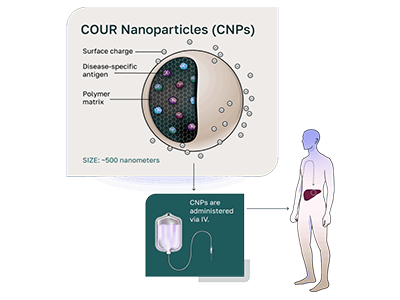
COUR Pharmaceuticals has developed a proprietary nanoparticle-based immune tolerance platform designed to retrain the immune system to recognize specific antigens as harmless rather than triggering an inflammatory response. By delivering disease-relevant antigens in a tolerogenic context, the platform seeks to address the underlying cause of autoimmune disease and offers the potential for durable disease modification without broad immunosuppression.
Pipeline programs include:
CNP-101 (Celiac Disease): Encapsulates gliadin proteins to promote immune tolerance to gluten. The program received FDA Fast Track designation and demonstrated encouraging results in a Phase 1/2a clinical trial. The technology was licensed to Takeda and is currently being evaluated in a Phase 2b clinical trial.
CNP-103 (Type 1 Diabetes): Designed to prevent autoimmune destruction of insulin-producing pancreatic beta cells. The program is currently being evaluated in a clinical trial enrolling newly diagnosed adolescents and adults and received FDA Fast Track designation in 2025.
CNP-104 (Primary Biliary Cholangitis): Targets mitochondrial antigens associated with autoimmune bile duct destruction. The program has received both Orphan Drug and Fast Track designations, and Phase 1/2a clinical data demonstrated reductions in liver enzymes and liver stiffness.
CNP-106 (Myasthenia Gravis): Designed to induce tolerance to autoantigens involved in acetylcholine receptor-mediated disease. The program received Orphan Drug designation and entered Phase 1b/2a clinical evaluation in 2024.
Genentech Collaboration: COUR is collaborating with Genentech to apply its immune tolerance platform to additional autoimmune disease indications.
Seeing this technology progress from concept to clinical trials has been extraordinarily rewarding. I am confident it will redefine how we treat autoimmune disease in the years ahead.”
— Stephen Miller, PhD Professor Emeritus, Feinberg School of Medicine
Benefits
Antigen-Specific Tolerance: Directly addresses disease drivers rather than suppressing the entire immune system.
Reduced Side Effects: Avoids risks associated with chronic immunosuppression.
Durable Impact: Potential to modify disease course and improve long-term outcomes.
Regulatory Momentum: Multiple Fast Track and Orphan Drug designations highlight FDA recognition of unmet need.
Technology & Commercialization Status
COUR Pharmaceuticals’ technology is rooted in pioneering research by Feinberg's Dr. Stephen Miller and former McCormick Professor Lonnie Shea, whose work demonstrated that antigen-loaded nanoparticles could be used to induce antigen-specific immune tolerance. Their research provided important scientific evidence that autoimmune responses could be selectively modulated without broadly suppressing the immune system, establishing a foundation for the development of new tolerance-inducing therapies.
Building on these advances, COUR Pharmaceuticals developed a nanoparticle-based platform designed to deliver disease-specific antigens in a tolerogenic manner and advanced the technology into clinical development across multiple autoimmune indications.
COUR’s pipeline is progressing across multiple stages: CNP-101 and CNP-104 have completed early clinical studies, while CNP-103 and CNP-106 are in active clinical trials. In October 2024, COUR dosed the first patient in its Phase 1b/2a proof-of-concept trial for CNP-106 in generalized myasthenia gravis.
Then, in August 2025, the first patient was dosed in its Phase 1b/2a clinical trial for CNP-103 in people recently diagnosed with type 1 diabetes. With strong regulatory designations and ongoing clinical validation, COUR is positioning its nanoparticle tolerance therapies as transformative treatments for autoimmune diseases, aiming to shift the paradigm from symptom management to durable immune reprogramming.
Northwestern Innovators
Stephen D. Miller, PhD Professor Emeritus of Microbiology-Immunology Feinberg School of Medicine
Lonnie D. Shea, PhD Former Professor of Chemical and Biological Engineering McCormick School of Engineering