- NanoAL Commercializes Aluminum Alloy Powder
- Laser-melted Al-3.6Mn-2.0Fe-1.8Si-0.9Zr (wt%) alloy with outstanding creep resistance via formation of α-Al(FeMn)Si precipitates
- Microstructure and mechanical properties of Al-Mg-Zr alloys processed by selective laser melting
- Coarsening- and creep resistance of precipitation-strengthened Al–Mg–Zr alloys processed by selective laser melting
Addalloy 3T & 5T Powders
High-Performance Aluminum Alloys for Metal Additive Manufacturing
Problem
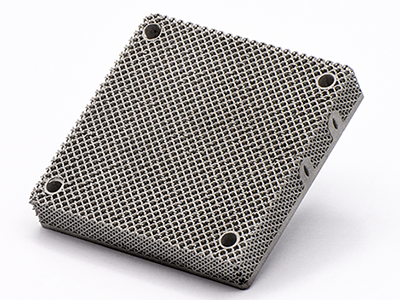
Aluminum is prized for its high-strength and low weight , making it essential in aerospace, automotive, and industrial applications. However, conventional aluminum powders used in additive manufacturing—especially aluminum-silicon alloys—often suffer from reduced mechanical properties, including low strength and poor ductility. Manufacturers need alloys that can deliver high strength, toughness, and reliability in laser powder bed fusion (LPBF) systems, while remaining cost-effective and easy to process.
Solution
NanoAL developed the Addalloy® family of aluminum powders to overcome these limitations.
Addalloy® 5T Powder is a proprietary aluminum-magnesium-based alloy designed for additive manufacturing. Unlike traditional 5000-series alloys, it is heat treatable, enabling precipitation strengthening through simple thermal treatments after printing. This allows mechanical properties to be tuned without deformation or work hardening. The powder is fully pre-alloyed, eliminating secondary processing, and is compatible with major LPBF platforms. Printed parts achieve 2X higher strength and ductility than incumbent Al-Si alloys, making 5T ideal for structural applications.
Addalloy® 3T Powder is proprietary aluminum-manganese-based alloy designed for elevated-temperature operating condition. Most additive aluminum alloys operate at 150oC or less, as their mechanical properties degrade at higher temperatures. Printed Addalloy® 3T components can operate at 250oC for a prolong periods without a drop in performance, making it suitable for applications such as heat exchangers or near-engine parts. Like 5T, it is pre-alloyed and designed for compatibility across additive manufacturing platforms.
Together, Addalloy® 5T and 3T give manufacturers tailored solutions: 5T for high-strength, demanding applications, and 3T for high-temperature operating condition.
Addalloy powders redefine what aluminum can do in additive manufacturing—empowering engineers to design lighter, stronger, and more complex components than ever before.”
— Nhon Vo, PhD
CEO, NanoAL
Benefits
- Superior Mechanical Properties: Compared with conventional Al‑Si powders.
- Heat Treatable Flexibility: Tailored performance, both at ambient and elevated temperatures.
- Ease of use: 100% pre-alloyed powders, no secondary processing required
- Compatibility: Seamless integration across leading laser powder bed fusion platforms.
Technology & Commercialization Status
Addalloy® aluminum alloy powders are based on advanced alloy design and processing research developed by McCormick Professors David Dunand and David Seidman, whose decade-spanning research in lightweight structural materials and powder metallurgy established the foundation for high-strength, printable aluminum alloys. Under the leadership of their postdoc, Dr. Nhon Vo, NanoAL translated this Northwestern-originated innovation into the commercial Addalloy® 5T and 3T powders, positioning them as next-generation aluminum materials for additive manufacturing.
Both powders have been validated for rapid prototyping and serial production of structural components across aerospace, automotive, and industrial applications. By combining high performance and printability, the Addalloy® family is enabling broader adoption of aluminum in metal 3D printing. NanoAL is a division of Steel Dynamics, operating within the Aluminum Dynamics subsidiary. Addalloy® aluminum alloy powders are produced and sold globally through their commercialization partner Mitsubishi RtM.
Northwestern Inventors
David C. Dunand, PhD
Professor of Materials Science and Engineering
McCormick School of Engineering
David N. Seidman, PhD
Walter P. Murphy Professor Emeritus of Materials Science
McCormick School of Engineering