Northwestern UniversityOffice for Research

Northwestern University - Office for Research

From University Research Lab to the Marketplace

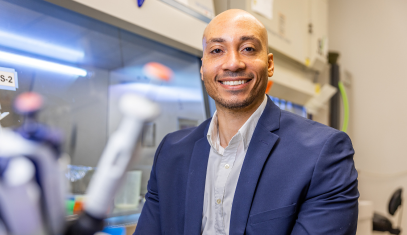
'Assistant Professor C. Shad Thaxton, Northwestern Department of Urology, co-founded AuraSense in 2009 with Professor Chad Mirkin, Director of the International Institute of Nanotechnology. AuraSense develops medical therapies and intra-cellular biomolecule detection assays using nanoparticle technology. Thaxton talks with INVO about taking AuraSense technology from a university research lab to the marketplace.

What is AuraSense? How did it get started?

AuraSense is a company that centers around the development of nanoparticles used as therapeutics and intra-cellular biomolecule detection probes. All of these technologies were either developed in Dr. Mirkin's laboratory or in my laboratory. All of the intellectual property was developed here at Northwestern.
AuraSense worked with Northwestern to license these technologies, and now it's our job to commercialize them and develop products out of them. That's the challenge that we are tackling right now.

It really started at the basic science level. For instance, nanoparticles for gene regulation were first investigated in Dr. Mirkin’s laboratory. the best approach was to start a company, license the relevant intellectual property, and then begin to build partnerships with industry to generate capitalAfter demonstrating that they could work to regulate target genes in human cells, that technology was certainly thought of as a potential therapeutic, but the question was how to take the basic idea and early data, and turn gene-regulating nanoparticles into a product. To do that takes a significant amount of money, time, and expertise not typically found in an academic laboratory. To facilitate that, the best approach was to start a company, license the relevant intellectual property, and then begin to build partnerships with industry to generate capital, make rapid progress, and to take advantage of partners' experience in therapeutic development.

What are some of the company's major milestones?

Formation of the company as a legal entity; negotiating the license with Northwestern and licensing the technology into the company; putting together a core group of people to drive commercialization efforts; hiring scientists to develop and nurture partnerships; building a laboratory that is steadily generating results for partners and our first, second and third partnerships with a major pharmaceutical companies for technologies being developed at AuraSense.

What are some of AuraSense’s short term and long term goals?

The most important short-term goals for the company include making good on the partnerships that we're currently engaged in, building our relationships with those companies, and continuing to demonstrate the power of the technologies that AuraSense is developing.

Our ultimate goal is to have each of the technologies that have been licensed to AuraSense as commercial products that are benefitting patients, whether as a therapeutics or through our intra-cellular detection platform.

What advice do you have for first-time inventors turned entrepreneurs?

Having good mentorship and people with experience, especially if you’re doing it for the first time, is very important.

Being patient but persistent is also very important. No matter how fast one wants the process to move, there are always “i’s” to dot and “t’s” to cross, and that takes time.

I would encourage Northwestern researchers to disclose potential inventions early, and often, and utilize the INVO office to protect inventions.

What fundraising tips or advice do you have?

AuraSense has had three main funding sources; the first is private individuals. We started with a round of equity investment.

Our second major source is our partnerships. We’ve gone to big companies, interested them in the technology, and then in investing in the technology for co-development.

Third is through government funding, including SBIR and STTR grants. AuraSense has submitted a number of these grants and has been successful multiple times. They bring in money to drive forward specific projects that are both scientifically significant and have high commercial potential.

Be as broad and open minded about funding as you can be. Certainly, one would like to keep as much ownership and control over the technology as possible. Venture capital investment is definitely another possibility that can input significant capital and really drive the development of the technology.

How do you balance research and the commercial demands of the marketplace?

It means a product that can be built reliably, put in a box and sold to customers.The research is driven by the intellectual curiosities of the people who are in the laboratory. We're on the academic side, really driving the technology forward to specifically address the limitations that current technologies face.

The commercial side—they’re looking for products and to generate a profit. Their goal is to prepare technologies for the marketplace, taking them well beyond proof of concept or an experiment that meets a scientific milestone. It means a product that can be built reliably, put in a box and sold to customers.
Those two things are very different, and that’s the challenge for AuraSense—being able to take what is done in the research lab and translate it into a real product that is functional, very easy to use, and addresses specific shortcomings of conventional technology.

What suggestions do you have for making the leap from lab to marketplace?

AuraSense is lucky from a standpoint that a number of different technologies have been licensed to the company. Some of the technologies have promise on the relative short-term and some of them on a longer time scale.

To a certain extent we've focused on all the technologies. But we’ve been able to leverage some of the near-term opportunities to help support those projects and also build the case for some of the longer term opportunities.

The longer term opportunities are more difficult because there can be a significant gap between basic science, proof of concept and commercial products. Especially in therapeutics, this “valley of death” exists because of the amount of money required to take a proof-of-concept therapeutic into human trials and beyond. You have to be pretty open to all types of funding sources including aggressive partnerships with pharmaceutical companies and other organizations.

As mentioned, government grants are a good way to raise initial money and keep the technology steadily moving forward in the early going.

What are your thoughts on dealing with partnerships?

One of the main things is diligence and patience. Some of these larger companies work much slower than you would like. Have good mentors with experience. Seek advice from people who've done it before so that one can understand how much the technology is worth at a specific development stage. Experience at all levels from the business, science, and intellectual property side—you really need it to help navigate a successful relationship with a partner.

What is it like being an entrepreneur?

It's very exciting. And, personally, I'm very excited about the opportunities at AuraSense, and the possibility of moving things from the laboratory—where they have promise—into patients where we have high hopes that they will have a significant and positive impact. Ultimately, seeing a good idea turn into an effective therapy would be amazingly rewarding.

Northwestern University